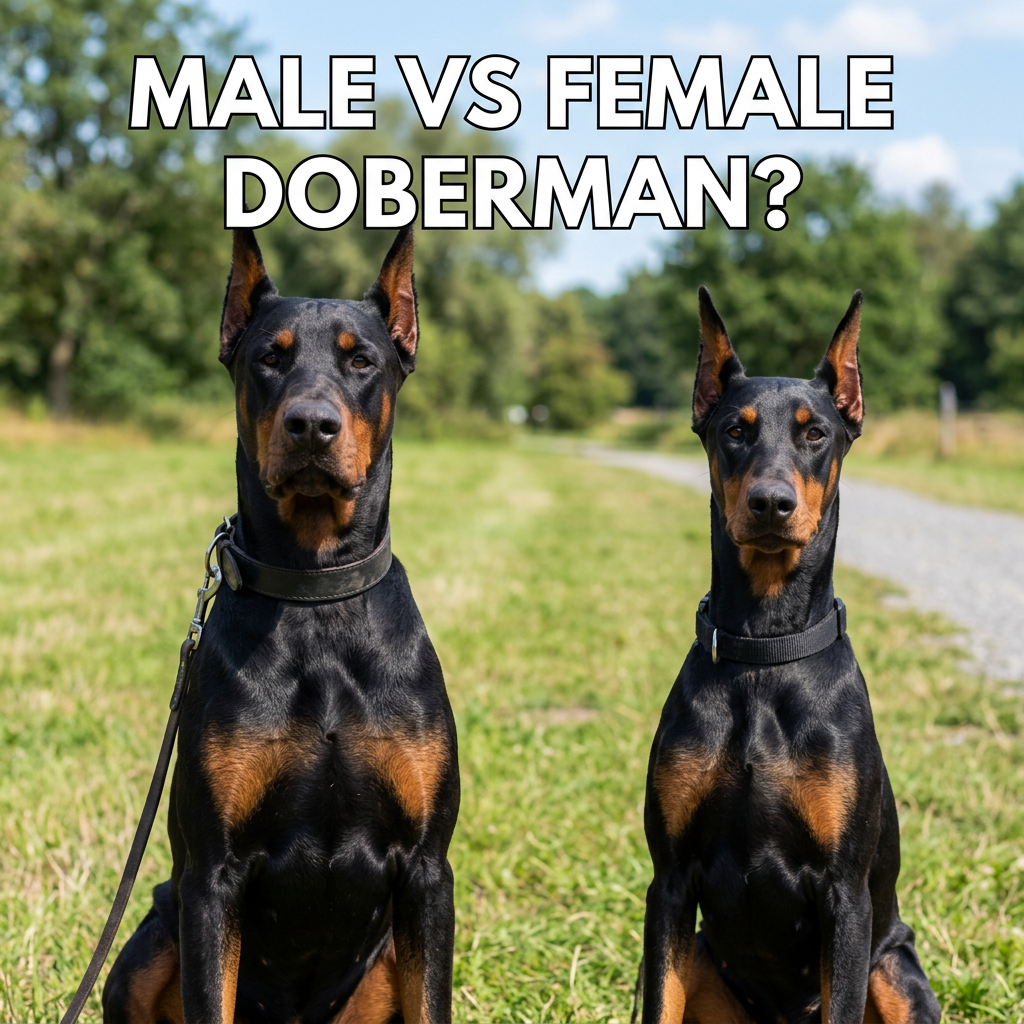
Male vs Female Doberman: Which Is Better? (Complete UK Buyer’s Guide 2026)
Choosing between a male and female Doberman is one of the biggest decisions you’ll make before bringing a puppy home. While both make exceptional companions, loyal family members, and capable protectors, there are important differences in size, temperament, maturity, and training that can make one a better fit for your lifestyle.
In this guide, we’ll compare male vs female Dobermans so you can decide which is the right choice for your family.
Quick Answer
If you’re looking for a larger, affectionate “velcro dog” that thrives on human companionship, a male Doberman may be your best choice.
If you prefer a slightly smaller, faster-maturing, more independent dog, a female Doberman may suit you better.
The truth is, a well-bred, well-socialised Doberman of either sex will usually have a much greater impact on your experience than whether you choose a male or female.
Male vs Female Doberman at a Glance
| Trait | Male Doberman | Female Doberman |
|---|---|---|
| Height | 68–72 cm | 63–68 cm |
| Weight | 40–45 kg | 32–35 kg |
| Build | Broader and heavier | Leaner and more athletic |
| Maturity | Around 3 years | Around 2 years |
| Affection | Extremely affectionate | Affectionate but often slightly more independent |
| Trainability | Eager to please | Intelligent and quick learners |
| Energy | High | High |
| Guarding | Excellent | Excellent |
| First-time owners | Suitable with commitment | Suitable with commitment |
Size Differences
One of the most noticeable differences between male and female Dobermans is their size.
Male Dobermans are noticeably larger, with broader chests, thicker necks and more substantial bone.
Female Dobermans tend to have a more elegant, athletic appearance and are generally easier to manage physically.
For owners who enjoy hiking, agility or active sports, many appreciate the female’s lighter frame. Those looking for a more imposing presence often prefer males.
Temperament
This is the question almost every prospective owner asks:
Are male or female Dobermans friendlier?
Generally speaking…
Male Dobermans
Many owners describe males as:
- extremely people-oriented
- affectionate
- playful
- attention-seeking
- “big babies”
Male Dobermans often form incredibly close bonds with their families and are famous for following their owners from room to room—earning the nickname “Velcro Dogs.”
Female Dobermans
Females are often described as:
- highly intelligent
- observant
- confident
- independent
- quick to mature
They are usually every bit as loyal but may be slightly less demanding of constant attention than males.
It’s important to remember these are general tendencies, not rules. Every dog’s personality is influenced by genetics, early socialisation, training and life experiences.
Which Is Easier to Train?
Both sexes are exceptionally intelligent and highly trainable.
Dobermans consistently rank among the world’s smartest working breeds and excel in:
- obedience
- scent work
- agility
- protection sports
- assistance work
Some trainers find females mature mentally a little earlier, making them easier to focus during adolescence.
Males may stay more puppy-like for longer but are often extremely eager to please once they mature.
Consistency, positive reinforcement and regular training matter far more than whether your puppy is male or female.
Which Makes the Better Family Dog?
The answer is simple:
Both can make wonderful family companions.
When properly raised, Dobermans are known for:
- loyalty
- affection
- intelligence
- gentleness with children
- strong desire to be part of family life
A responsible breeder who prioritises stable temperament is far more important than choosing one sex over the other.
Which Is More Protective?
Many people assume male Dobermans are naturally better guard dogs because of their larger size.
In reality, both males and females have strong protective instincts.
A confident female Doberman can be every bit as capable of alerting her family to unusual situations and acting as a deterrent.
Protection is influenced more by:
- genetics
- confidence
- breeding
- socialisation
- training
than by sex alone.
Exercise Requirements
Male and female Dobermans both require plenty of physical exercise and mental stimulation.
Adult Dobermans typically benefit from:
- daily walks
- structured training
- scent games
- enrichment activities
- opportunities to run safely in secure areas
Without sufficient stimulation, boredom can lead to unwanted behaviours such as chewing, excessive barking or digging.
Health Considerations
Both male and female Dobermans can be affected by inherited health conditions, including:
- Dilated Cardiomyopathy (DCM)
- von Willebrand Disease (vWD)
- Hip Dysplasia
- Eye conditions
- Thyroid disorders
This is why choosing a breeder who health tests their breeding dogs is one of the most important decisions you’ll make.
Health testing helps reduce the risk of passing inherited conditions to future generations, although no breeder can guarantee a puppy will never develop health problems.
Living With Male Dobermans
Pros
- Extremely affectionate
- Larger physical presence
- Strong family bond
- Often very playful
- Excellent companions
Cons
- Larger and stronger to manage
- Mature more slowly
- Can remain boisterous for longer
- Eat more food
Living With Female Dobermans
Pros
- Slightly smaller
- Mature earlier
- Athletic and agile
- Often easier to manage physically
Cons
- Can be more independent
- Come into season if not spayed
- Slightly less physically imposing
Which Should First-Time Owners Choose?
For most families, the better choice isn’t determined by sex—it’s determined by the individual puppy and the breeder.
A breeder who carefully matches puppies to each family’s lifestyle can often make a far better recommendation than choosing solely based on whether the puppy is male or female.
How We Match Puppies to Families
At Regalis Dynasty, we believe temperament matters far more than colour or sex.
Every puppy is carefully observed from an early age to understand traits such as:
- confidence
- curiosity
- resilience
- food motivation
- recovery from new experiences
- sociability
- willingness to engage with people
This allows us to recommend puppies based on the lifestyle, experience and goals of each family whenever possible.
Whether you’re looking for an active companion, a family dog or a puppy with strong working potential, our aim is to help you find the best match.
Frequently Asked Questions
Are male Dobermans more affectionate?
Many owners find males to be especially affectionate and people-focused, although individual personalities vary.
Are female Dobermans easier to train?
Females often mature earlier, but both sexes are highly intelligent and respond well to consistent, positive training.
Which Doberman is calmer?
Neither sex is naturally calm as a puppy. Females may mature slightly sooner, while males can stay playful for longer. Adult temperament depends heavily on breeding, training and lifestyle.
Are male Dobermans bigger?
Yes. Males are generally taller, heavier and more muscular than females.
Should I get a male or female Doberman?
Choose the puppy whose temperament best suits your household. A responsible breeder can help match you with the right individual rather than recommending a puppy based only on sex.
Final Thoughts
There is no universally “better” choice between a male and female Doberman.
Both have the intelligence, loyalty and devotion that have made the breed one of the world’s most admired working and companion dogs. The biggest factors in raising a confident, well-adjusted Doberman are responsible breeding, early socialisation, consistent training and an owner committed to meeting the breed’s physical and mental needs.
If you’re considering welcoming a Doberman into your family, take the time to meet the breeder, ask about health testing, and discuss your lifestyle and expectations. The right puppy is the one whose temperament and needs align with your home—not simply the one that happens to be male or female.